Letter 14 of 28 · Ages 4–7 · Pre-K – Grade 1
Arabic Letter Sad (ص) — Free Tracing Worksheet
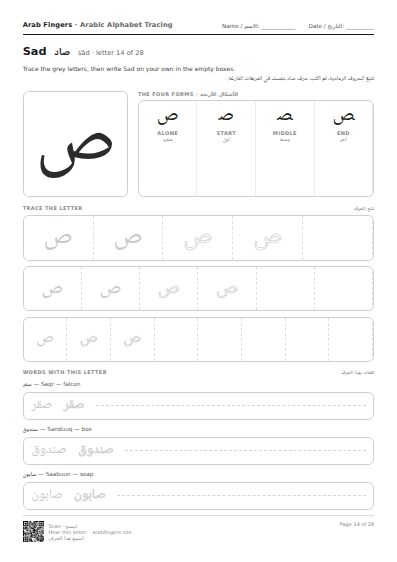
Free Sad (ص) tracing worksheet: the letter large in Naskh, its four joined forms, graded tracing rows and 3 words to trace, plus a colour-and-find sheet. Pronounced "ṣād". No email, no signup.
2 pages (tracing + colour & find) · 196 KB · no email, no account, no watermark.
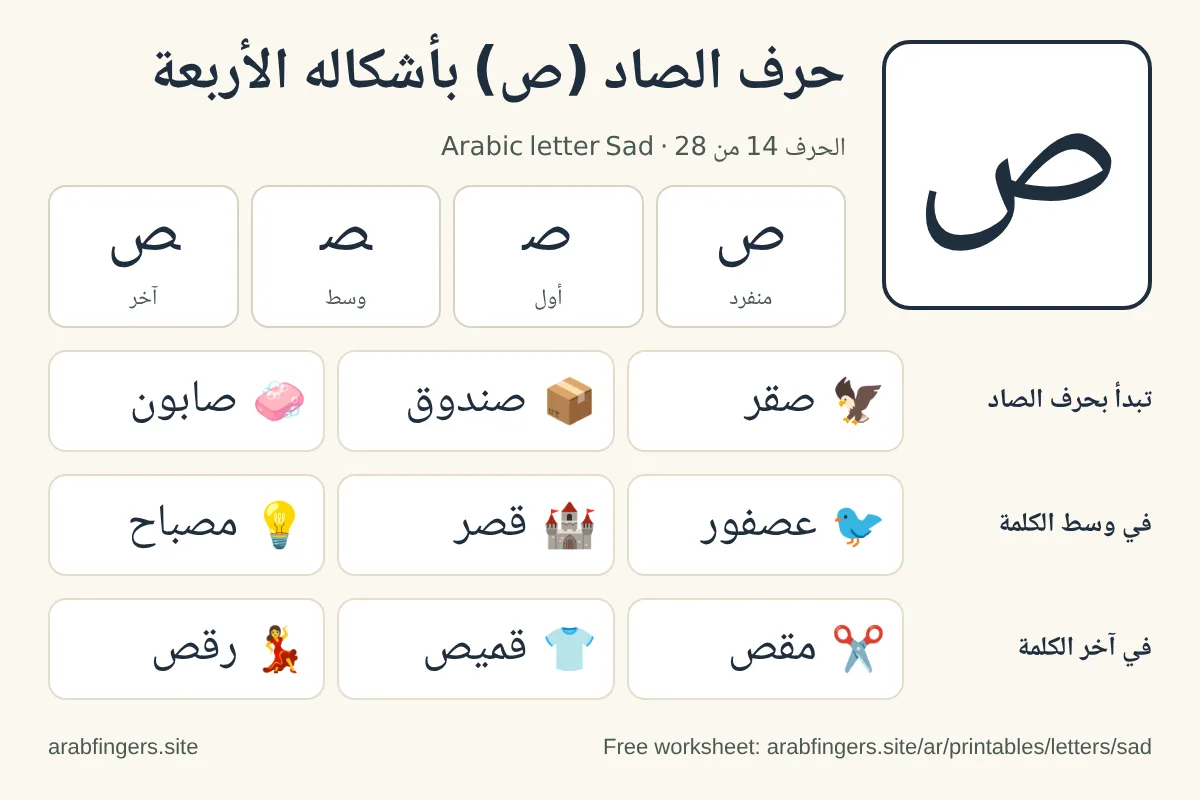
The four shapes of Sad (ص)
Arabic letters change shape depending on where they sit in a word. The same sheet your child traces shows all four, so the changing shape is learned from day one instead of coming as a surprise later.
How to pronounce Sad
“ṣād”. Make an 's' sound, but pull the back of your tongue up and back so the whole mouth feels full and the sound turns dark and heavy. This is the emphatic 's' — same tip position as س, but the throat and tongue body raise to deepen it.
No exact English equivalent — start from 's' and make it heavy and hollow. The trap is saying a plain 's' instead; listen to the vowel after it — after ص it sounds deep and round ('SaH'), after س it stays bright.
The classic mix-up: Saying a plain 's' so 'Saqr' becomes 'saqr'. Have your child puff the cheeks slightly and let the sound 'sit heavy' in the mouth — the fuller posture is what makes ص emphatic.
Words with Sad (ص), with pictures
Sad changes shape at the start, in the middle and at the end of a word. Say each word, point to the picture, then find the letter in it together.
Words that start with Sad
- صقرfalcon
- صندوقbox
- صابونsoap
Sad in the middle of the word
- عصفورsparrow
- قصرpalace
- مصباحlamp
Words that end with Sad
- مقصscissors
- قميصshirt
- رقصdancing
One activity for this week
Play 'big falcon, small snake': say 'Saqr' in a big, deep falcon voice and 'samaka' in a thin snake voice. Contrasting heavy and light back to back trains the ص vs س distinction.
Sad is week 14 of the letter-of-the-week plan: five ten-minute days for each letter.
Questions
How do you pronounce the Arabic letter Sad (ص)?
Make an 's' sound, but pull the back of your tongue up and back so the whole mouth feels full and the sound turns dark and heavy. This is the emphatic 's' — same tip position as س, but the throat and tongue body raise to deepen it. No exact English equivalent — start from 's' and make it heavy and hollow. The trap is saying a plain 's' instead; listen to the vowel after it — after ص it sounds deep and round ('SaH'), after س it stays bright.
How many dots does the Arabic letter Sad (ص) have?
Sad (ص) has no dots.
What words start with Sad (ص) in Arabic?
صقر (falcon), صندوق (box), صابون (soap). With Sad in the middle: عصفور (sparrow), قصر (palace), مصباح (lamp); at the end: مقص (scissors), قميص (shirt), رقص (dancing).
What is the most common mistake with Sad?
Saying a plain 's' so 'Saqr' becomes 'saqr'. Have your child puff the cheeks slightly and let the sound 'sit heavy' in the mouth — the fuller posture is what makes ص emphatic.
How should I use this Sad worksheet with my child?
Start by tracing the grey letters with a finger — saying "ṣād" out loud each time — then move to pencil on the dotted row, and finish with the empty boxes. Play 'big falcon, small snake': say 'Saqr' in a big, deep falcon voice and 'samaka' in a thin snake voice. Contrasting heavy and light back to back trains the ص vs س distinction.
Every letter has its own page
Want all 28 in one file? Download the complete alphabet pack →