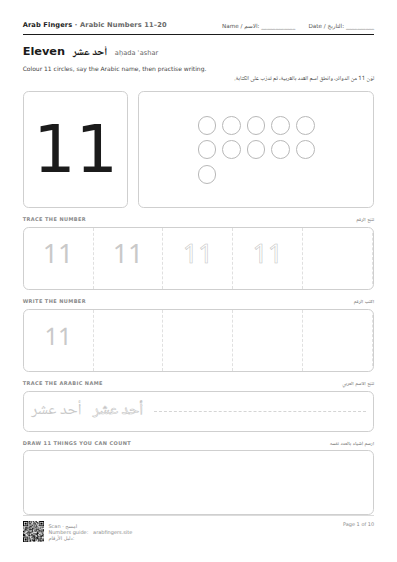
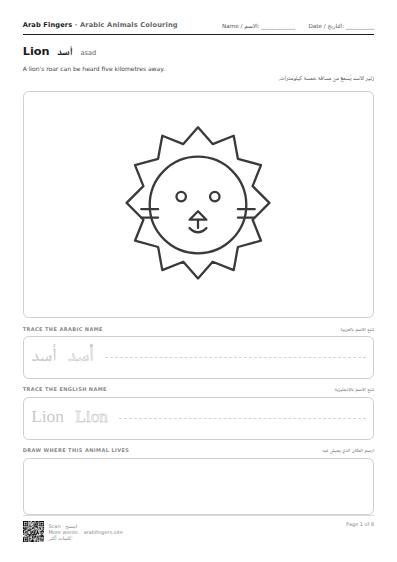
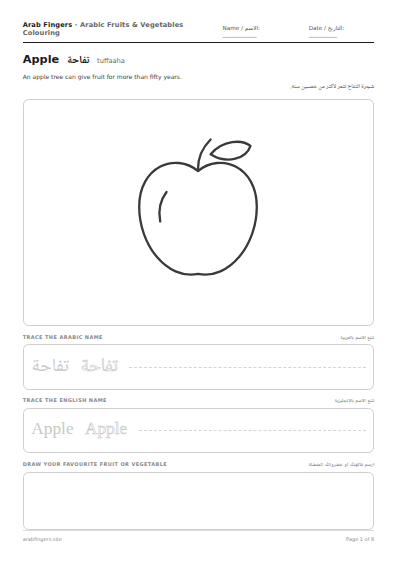
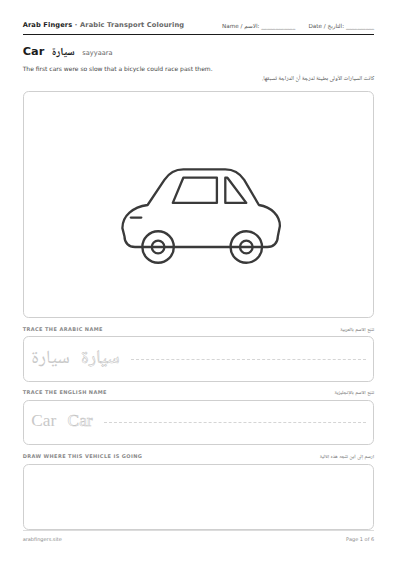
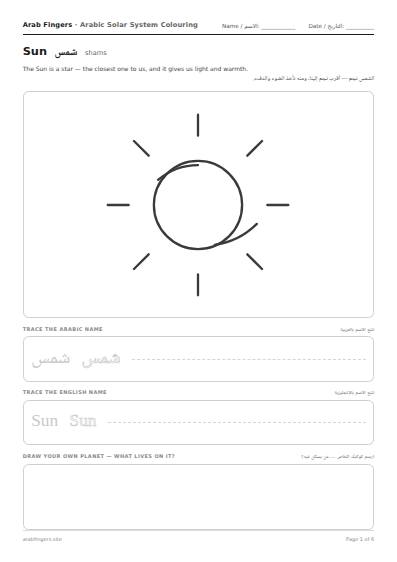
Every worksheet on this page is a real PDF you can download and print — 176 pages in total, covering all 28 Arabic letters, the short vowels (harakat), the numbers 1 to 20, colours and animals. There is no signup, no email wall and no watermark. Click a pack, the file downloads, you print it.
All the packs, one easy download
Complete Arabic Workbook
176 pages · PDF · 4.9 MB · A4 · Ages 3–7
Letters, harakat, numbers and colouring in one file. Download once, then print just the pages your child is ready for today.
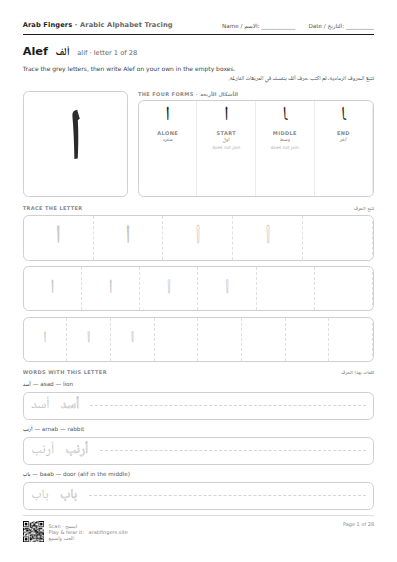
One full page for every letter of the Arabic alphabet: the letter shown large, its four joined forms, three graded tracing rows, and two example words to trace.
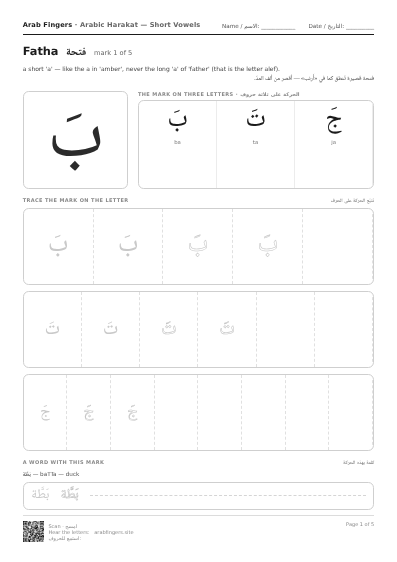
Five sheets covering fatha, kasra, damma, sukoon and tanween: each mark traced onto real letters, with an example word and how the mark changes its sound.
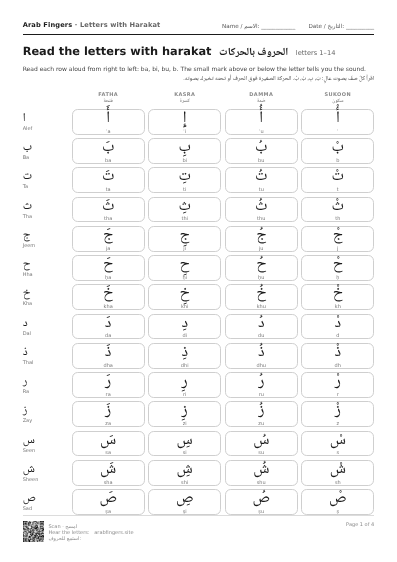
All 28 letters with fatha, kasra, damma and sukoon — بَ بِ بُ بْ — on a two-page reading chart with the sound of each, then the same grid hollow for tracing.
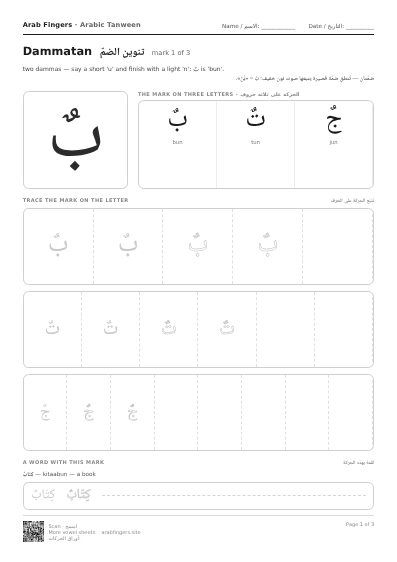
Three sheets for the three tanween endings — dammatan, fathatan and kasratan — each traced onto real letters and shown on the same word, كتابٌ / كتابًا / كتابٍ, so only the ending changes.
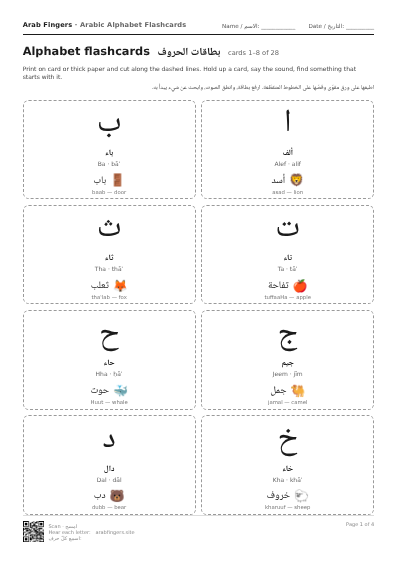
All 28 letters as cut-out flashcards, eight to a page: the letter large, its Arabic and English name, and a picture word that starts with it. Print on card, cut, play.
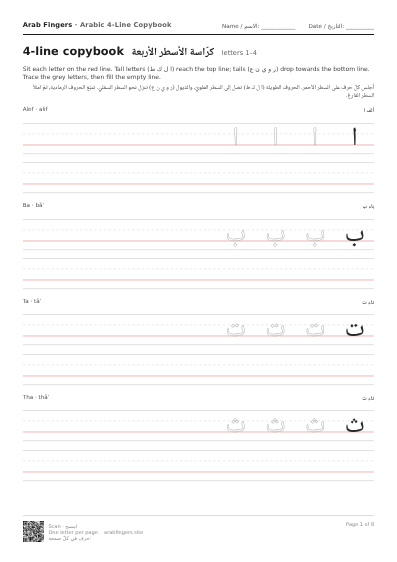
The 4-line ruled format many schools use: every letter written on the red baseline with its tall strokes and tails in place, three copies to trace and an empty line to write. Plus a blank 4-line page.
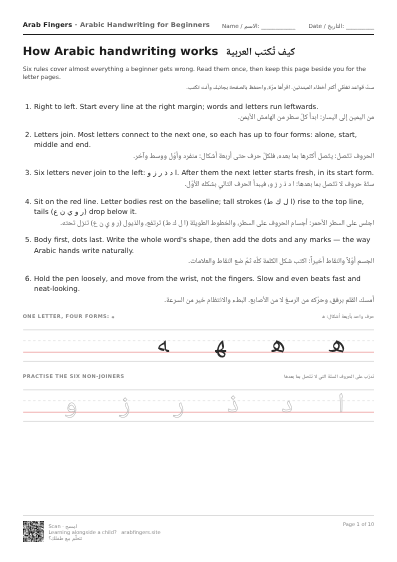
A plain, grown-up workbook: the six rules of Arabic handwriting, every letter in its four forms on 4-line ruling to trace and copy, and twelve everyday words for joining practice.
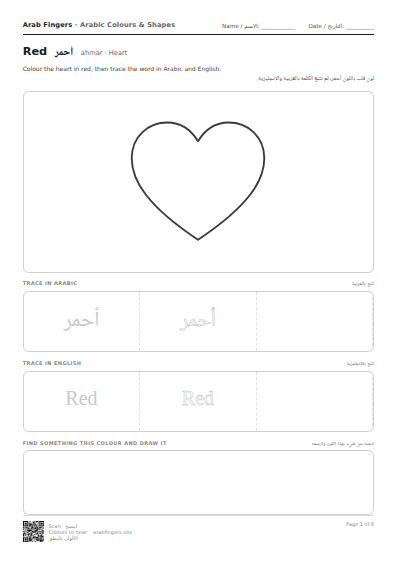
Eight fruits and vegetables with a large outline drawing to colour, the name to trace in Arabic and English, and a one-line fact a parent can read aloud.
The sun, the moon, the earth, Saturn, a star and a rocket — big outlines to colour with the Arabic and English names to trace. Pairs with our Solar System lesson.
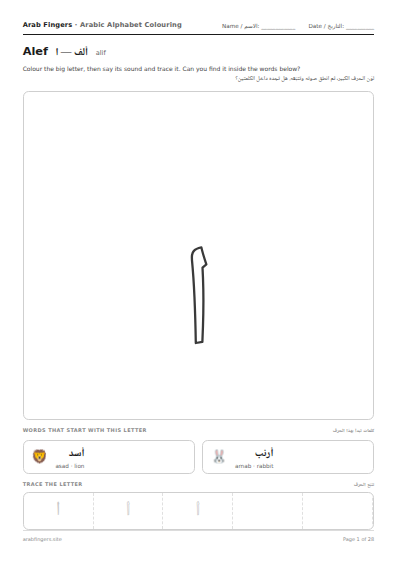
All 28 letters as huge outlined bubble letters to colour in, with each letter's example words and a tracing row. The colouring companion to the tracing pack.
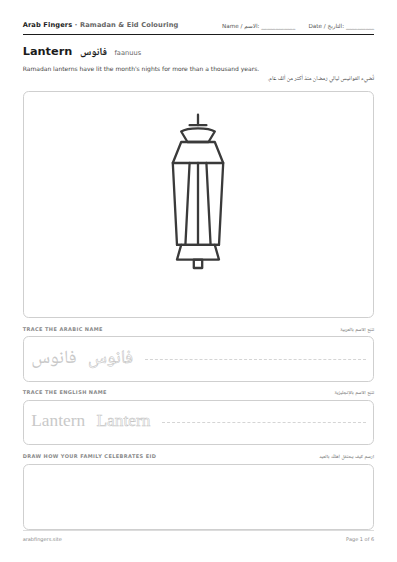
Six pages of Ramadan and Eid — lantern, mosque, crescent, dates, gift and balloon — with the Arabic and English names to trace. Pairs with the story 'The Little Lantern'.
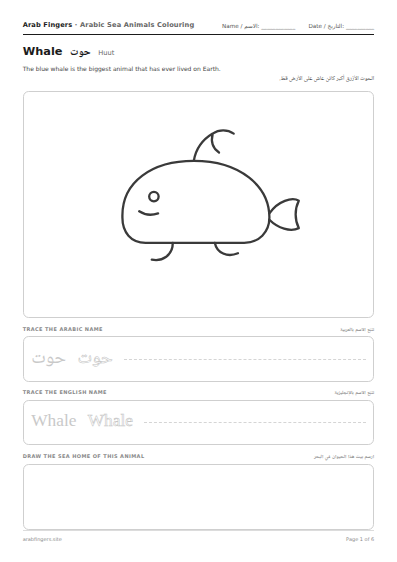
Six sea creatures — whale, octopus, crab, turtle, dolphin and starfish — with big outlines to colour and bilingual name tracing. Pairs with the story 'The Little Whale'.
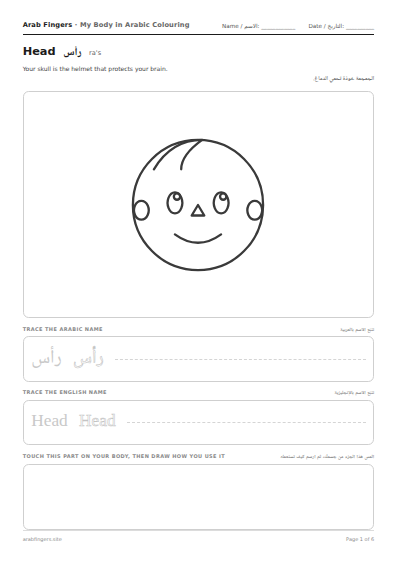
Six body parts — head, eye, ear, mouth, hand and foot — with big outlines to colour and the Arabic and English names to trace. Colour the part, then touch it on yourself.
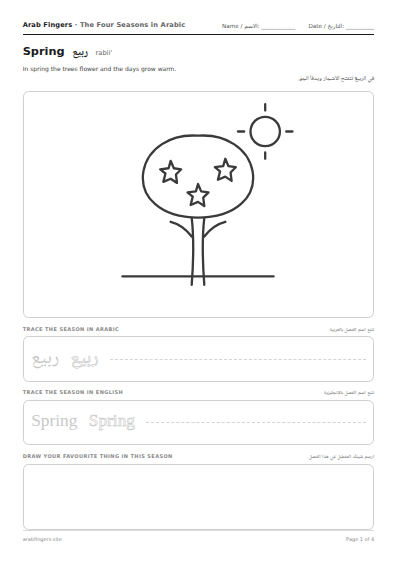
The same tree through four seasons — spring blossom, summer sun, falling autumn leaves and winter snow — one colouring scene per season with the Arabic name to trace.
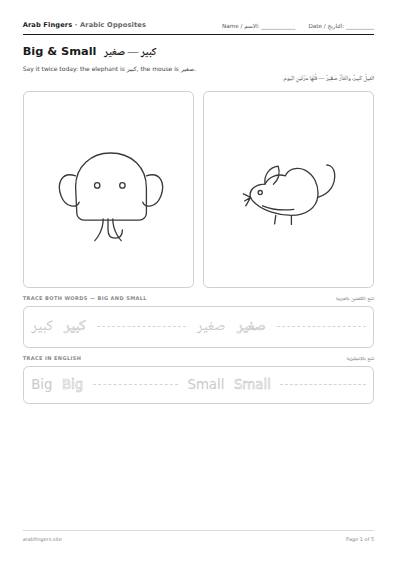
Five opposite pairs on facing outlines — big and small, day and night, hot and cold, full and empty, fast and slow — colour both sides and trace both words.
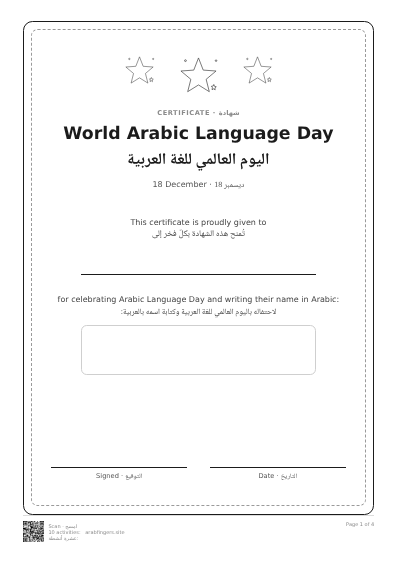
Four pages for 18 December: a certificate with a box for the child's name in Arabic, an 'I love Arabic' poster to colour, a write-your-name and letter-hunt sheet, and Arabic words and facts to trace.
Every pack in this library bound into one file, in teaching order — the alphabet chart first, then letters, harakat, numbers, colours, animals and all the colouring books. One download, one print job.
Ages are a guide. Your saved activities stay in this browser only.
FROM OTHER CREATORS
More to discover, with credit to the creators
Explore these independent resources alongside Arab Fingers worksheets. Each link opens the original publisher, where you can download under their terms.
Korkortoon
Arabic learning & colouring books
Explore alphabet, animal, transport and space colouring books from Korkortoon.
Every letter has its own page: a standalone PDF sheet, the letter pronounced at the click of a button, how to say it for non-Arabic-speaking parents, its four shapes, and example words. Start wherever your child is.
Tracing works best in short, frequent sessions rather than long ones. A single letter per day, five minutes at a time, will take a child through the whole alphabet in about a month and hold their attention far better than working through ten pages on a Saturday.
1
Say the letter before writing it
Handwriting sticks faster when the sound is already in the child's ear. Say the letter name, have your child repeat it, and only then put the pencil down. If you are not a confident Arabic speaker, play the letter in the letter game first and copy the pronunciation you hear.
2
Trace the grey letters, across the row in order
The first two letters in every row are printed in solid grey to follow. The next two are hollow outlines, which force the child to control the stroke rather than colour inside a shape. The remaining boxes are empty. Do not skip ahead to the empty boxes — the graded sequence is what builds the muscle memory.
3
Point out the four forms
Arabic letters change shape depending on where they sit in a word. Every letter sheet shows all four forms side by side — alone, at the start, in the middle, and at the end. Children who meet this early stop being surprised by it later. Six letters (ا د ذ ر ز و) never join to the letter after them, and their sheets say so.
4
Finish with the example words
The bottom of each letter sheet has two or three real words that contain the letter, with a transliteration and an English meaning. Tracing a whole word is the point where a child stops drawing shapes and starts writing Arabic.
5
Keep the finished pages
Put each completed sheet in a folder in alphabet order. By the end you have a workbook your child made, which is a far better prompt for revision than starting again from a blank page.
What is on every letter sheet
We built these sheets because most free Arabic tracing worksheets online are a single scanned page, printed either too faint to follow or too dark to trace over. Ours are typeset in Noto Naskh — the same clear naskh script children meet in school books — at a size a four-year-old can actually control, with the tracing guides graded from solid grey to a hollow outline to nothing at all, so a child leaves each page writing unaided.
The letter, large
A reference version at the top of the page, big enough to study the shape properly before copying it.
All four joined forms
Isolated, initial, medial and final, each labelled in English and Arabic.
Three graded tracing rows
Five large letters, then six medium, then eight small — the size drops as control improves.
Two or three example words
With transliteration and meaning, each on its own dashed writing line.
A name and date line
So a teacher handing out thirty copies can tell them apart.
Black and white only
No colour blocks, no photographs, no background fills. These print on a cheap mono laser printer without draining a cartridge.
Printing tips
Print at 100%, not “fit to page”
The sheets are laid out for A4. Scaling shrinks the tracing boxes below a comfortable size for small hands. If your printer defaults to US Letter, choose A4 or accept slightly wider margins — do not tick “shrink to fit”.
Use the greyscale setting
Everything is already black and grey, so greyscale changes nothing visually and stops a colour printer mixing cartridges to make grey.
Slip one page into a plastic sleeve
With a dry-wipe pen a single printed sheet becomes reusable indefinitely, which matters if your child wants to trace the same letter twenty times.
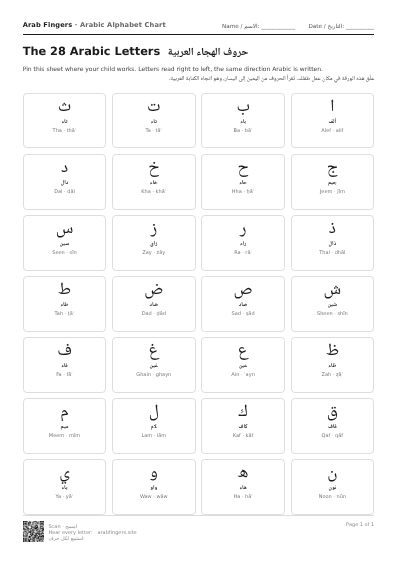
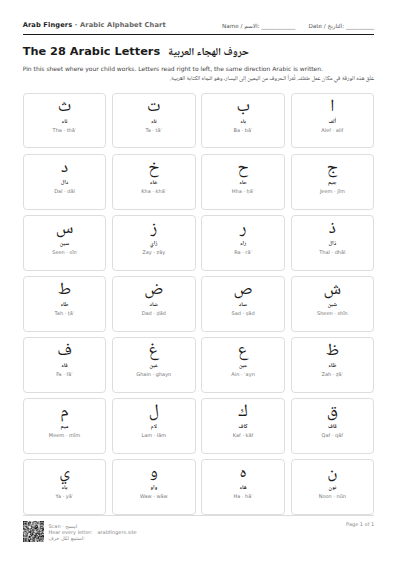
Print the chart once, the letters as you go
The one-page alphabet chart is a reference to pin on the wall. Printing all 28 letter sheets at once tends to produce a stack nobody works through.
Frequently asked questions about the worksheets
Are these Arabic tracing worksheets really free?+
Yes. Every pack downloads as a PDF with no signup, no account, no email address and no payment. There is no watermark and nothing is held back behind a paid version.
Can I use these worksheets in my classroom or madrasah?+
Yes. You may print and photocopy them for your class, your homeschool or your weekend school at no cost. Please do not re-upload the PDF files to another site or sell them; link to this page instead so families always get the current version.
What age are the Arabic worksheets for?+
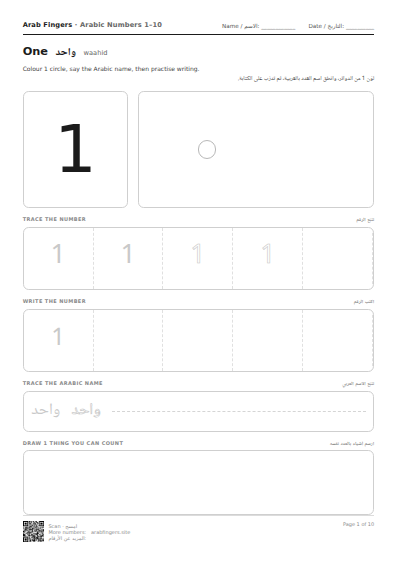
The letter and animal sheets suit children from about four to seven, once they can hold a pencil with some control. The numbers and colours sheets work from about three, because counting circles and colouring shapes need less precision than tracing a letter.
Why do the letters get smaller down the page?+
Because handwriting control develops from large movements to small ones. Starting a child on small letters produces cramped, tense writing. Each sheet starts at a size the whole arm can draw and finishes near normal writing size.
My printer makes the tracing letters too faint to see. What can I do?+
Turn off any toner-saving or draft mode, which is the usual cause. The tracing guides are printed in mid grey on purpose so a pencil line shows clearly on top of them, but draft mode drops them below the visible threshold.
Do the worksheets teach letters in alphabet order or by difficulty?+
Alphabet order, because that is the order children are taught in almost every Arabic curriculum and the order the alphabet song follows. If you would rather start with the easiest shapes, the alphabet guide marks each letter easy, medium or hard for English speakers.
What is the difference between the packs?+
The individual packs each cover one topic, including the alphabet chart, letter tracing, harakat (short vowels), numbers, colours and themed colouring books. The complete workbook collects every pack into a single file in teaching order. Choose it for the full library, or download an individual pack or a single letter sheet for a shorter activity.
What is the best way to use tracing sheets to teach the Arabic alphabet?+
Pair tracing with sound. Say the letter, let your child hear it in the letter game, then trace it on the worksheet. Seeing, hearing and writing the same letter in one short session fixes it far faster than tracing in silence.
Keep going
The worksheets train the hand. These guides train the ear and the eye.