Arabic Tanween Worksheets (ـٌ ـً ـٍ)
Three endings, one word: كتابٌ، كتابًا، كتابٍ — and a sheet for each.
3 pages · PDF · 0.2 MB · Ages 5–8
⬇ Download the PDF — freeNo email, no account, no watermark.
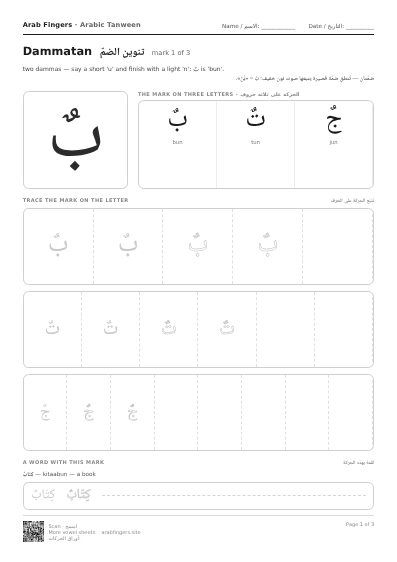
Three sheets for the three tanween endings — dammatan, fathatan and kasratan — each traced onto real letters and shown on the same word, كتابٌ / كتابًا / كتابٍ, so only the ending changes.
What is on the pages
- One sheet per tanween — dammatan, fathatan and kasratan — with the mark shown large on ب and on three letters with their sounds (bun, ban, bin).
- Fathatan written as it appears in real text, on an extra alif (بًا), with a note that the alif is not read.
- Three graded tracing rows per sheet, and the same word on every sheet so the only thing that changes is the ending.
How to use it
Do the harakat sheets first. Tanween is a doubled fatha, kasra or damma, so a child who reads بَ بِ بُ easily is ready for بًا بٍ بٌ.
Read the three sheets' words side by side at the end — kitaabun, kitaaban, kitaabin. Hearing the same word with three endings is the whole lesson.
Questions
What is tanween?
Tanween is a doubled vowel mark at the end of a word — ـٌ, ـً or ـٍ — read as the short vowel followed by a light 'n': un, an, in. It usually marks an indefinite noun, like 'a book'.
Why is there an alif after fathatan?
In ordinary spelling fathatan is written on an added alif — كتابًا — which is not pronounced. The exceptions (words ending in ة or a hamza after alif) come later; the sheets use the common form.
Ready to print
3 pages, 0.2 MB, free forever.
⬇ Download the PDFThe rest of the library
Arabic Alphabet Tracing Worksheets
28 pages · Ages 4–7
Arabic Alphabet Chart (1 page)
1 page · All ages
Arabic Numbers 1–10 Tracing Worksheets
10 pages · Ages 3–6
Arabic Numbers 11–20 Tracing Worksheets
10 pages · Ages 4–7
Arabic Short Vowels (Harakat) Worksheets
5 pages · Ages 5–8
Arabic Letters with Harakat (Chart + Tracing)
4 pages · Ages 5–8
Arabic Alphabet Flashcards (28 Cut-Out Cards)
4 pages · Ages 3–7
Arabic 4-Line Copybook (Handwriting Practice)
8 pages · Ages 5–9
Arabic Handwriting for Beginners (Teens & Adults)
10 pages · Ages 10–18 & adults
Arabic Colours & Shapes Worksheets
6 pages · Ages 3–6
Arabic Animals Colouring & Word Tracing
8 pages · Ages 3–7
Arabic Fruits & Vegetables Coloring Book
8 pages · Ages 3–7
Arabic Transport Coloring Book
6 pages · Ages 3–7
Arabic Solar System Coloring Book
6 pages · Ages 4–8
Arabic Alphabet Coloring Book — Big Bubble Letters
28 pages · Ages 3–6
Ramadan & Eid Coloring Book in Arabic
6 pages · Ages 3–7
Arabic Sea Animals Coloring Book
6 pages · Ages 3–7
My Body in Arabic — Coloring Book
6 pages · Ages 3–6
The Four Seasons in Arabic — Coloring Book
4 pages · Ages 4–7
Arabic Opposites Coloring Book
5 pages · Ages 4–7
Arabic Language Day Pack (18 December)
4 pages · Ages 4–8
Complete Arabic Workbook (everything above)
176 pages · Ages 3–7