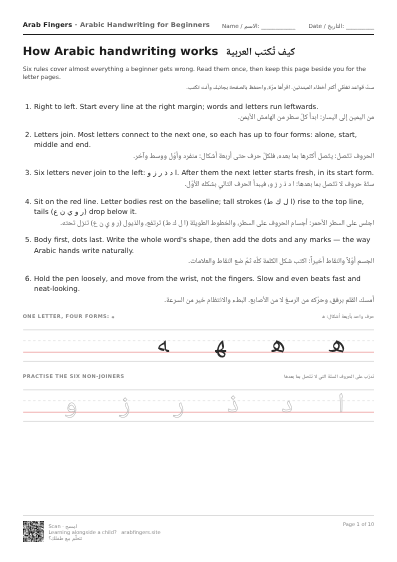
Arabic Handwriting for Beginners (Teens & Adults)
For the grown-up at the table — learning to write Arabic, or relearning it, at your own pace.
10 pages · PDF · 0.5 MB · Ages 10–18 & adults
⬇ Download the PDF — freeNo email, no account, no watermark.
A plain, grown-up workbook: the six rules of Arabic handwriting, every letter in its four forms on 4-line ruling to trace and copy, and twelve everyday words for joining practice.
What is on the pages
- A one-page primer: right to left, the four letter forms, the six letters that never join forwards (ا د ذ ر ز و), sitting on the baseline, and why the dots go on last.
- Seven pages covering all 28 letters, four per page: each letter's four forms — alone, start, middle, end — as a model and as outlines to trace, with an empty 4-line row to write them yourself.
- Two pages of joining practice with twelve everyday words (salaam, shukran, kitaab, qalam…), each with transliteration and meaning.
- A plain, adult layout — no cartoons — so it works for teenagers, parents learning alongside a child, and adult students.
How to use it
Do one letter page a day, about ten minutes: four letters, four forms each. In a week you have written the whole alphabet in every form it takes, which is what reading real Arabic requires.
Write slowly and keep the pen moving from right to left. Neatness comes from even, unhurried strokes, not from pressing hard; if your hand tires, you are gripping too tightly.
If you are learning so you can help a child, do your page while they do theirs. Children copy what the adults at the table are doing far more readily than what they are told.
Questions
Can an adult learn to write Arabic from worksheets?
Yes, for the handwriting itself. The script is learned the same way at any age — letter forms first, then joining, then words. What worksheets cannot give you is pronunciation, so pair them with audio: every letter on this site has a recording.
Why does each letter have four forms?
Because Arabic is joined writing. A letter takes one shape alone, another at the start of a word, another in the middle and another at the end. Six letters (ا د ذ ر ز و) never join to the next letter, so they only have two shapes in practice.
Which pen is best for practising Arabic handwriting?
Any pen that glides — a gel pen or a soft pencil — for these sheets. A broad calligraphy marker is a different skill; start with ordinary handwriting and add calligraphy later if you enjoy it.
Ready to print
10 pages, 0.5 MB, free forever.
⬇ Download the PDFThe rest of the library
Arabic Alphabet Tracing Worksheets
28 pages · Ages 4–7
Arabic Alphabet Chart (1 page)
1 page · All ages
Arabic Numbers 1–10 Tracing Worksheets
10 pages · Ages 3–6
Arabic Numbers 11–20 Tracing Worksheets
10 pages · Ages 4–7
Arabic Short Vowels (Harakat) Worksheets
5 pages · Ages 5–8
Arabic Letters with Harakat (Chart + Tracing)
4 pages · Ages 5–8
Arabic Tanween Worksheets (ـٌ ـً ـٍ)
3 pages · Ages 5–8
Arabic Alphabet Flashcards (28 Cut-Out Cards)
4 pages · Ages 3–7
Arabic 4-Line Copybook (Handwriting Practice)
8 pages · Ages 5–9
Arabic Colours & Shapes Worksheets
6 pages · Ages 3–6
Arabic Animals Colouring & Word Tracing
8 pages · Ages 3–7
Arabic Fruits & Vegetables Coloring Book
8 pages · Ages 3–7
Arabic Transport Coloring Book
6 pages · Ages 3–7
Arabic Solar System Coloring Book
6 pages · Ages 4–8
Arabic Alphabet Coloring Book — Big Bubble Letters
28 pages · Ages 3–6
Ramadan & Eid Coloring Book in Arabic
6 pages · Ages 3–7
Arabic Sea Animals Coloring Book
6 pages · Ages 3–7
My Body in Arabic — Coloring Book
6 pages · Ages 3–6
The Four Seasons in Arabic — Coloring Book
4 pages · Ages 4–7
Arabic Opposites Coloring Book
5 pages · Ages 4–7
Arabic Language Day Pack (18 December)
4 pages · Ages 4–8
Complete Arabic Workbook (everything above)
176 pages · Ages 3–7