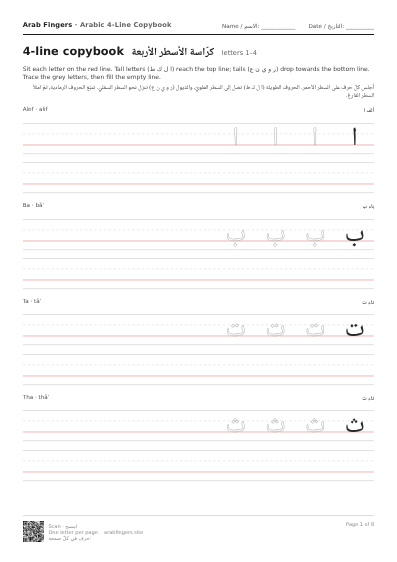
Arabic 4-Line Copybook (Handwriting Practice)
Where each letter sits on the line — the thing tracing sheets never show.
8 pages · PDF · 0.2 MB · Ages 5–9
⬇ Download the PDF — freeNo email, no account, no watermark.
The 4-line ruled format many schools use: every letter written on the red baseline with its tall strokes and tails in place, three copies to trace and an empty line to write. Plus a blank 4-line page.
What is on the pages
- Seven pages, four letters each: every letter on a 4-line row with the red baseline, tall letters (ا ل ك ط) up to the top line and tails (ر و ي ن ع) down towards the bottom one.
- Per letter: one solid model, three hollow copies to trace, and a full empty 4-line row to write on.
- An eighth page of blank 4-line rows for words, names and dictation.
How to use it
Use it after the one-letter tracing sheets, once a child can write a letter's shape: the copybook teaches the next thing, which is its size and where it sits.
Watch the red line. Most early Arabic handwriting problems are letters floating above the line or tails cut short; on four lines both are easy to see and easy to correct.
Questions
What is a 4-line copy?
A handwriting page ruled with four lines per row. The third (red) line is the baseline letters sit on; the lines above and below show how far tall strokes rise and tails drop. Many schools in South Asia and the Gulf use it for Arabic and English.
Is it only for children?
No — the same pages work for adult beginners learning to write Arabic neatly. Print the blank page for copying words once the letters are comfortable.
Ready to print
8 pages, 0.2 MB, free forever.
⬇ Download the PDFThe rest of the library
Arabic Alphabet Tracing Worksheets
28 pages · Ages 4–7
Arabic Alphabet Chart (1 page)
1 page · All ages
Arabic Numbers 1–10 Tracing Worksheets
10 pages · Ages 3–6
Arabic Numbers 11–20 Tracing Worksheets
10 pages · Ages 4–7
Arabic Short Vowels (Harakat) Worksheets
5 pages · Ages 5–8
Arabic Letters with Harakat (Chart + Tracing)
4 pages · Ages 5–8
Arabic Tanween Worksheets (ـٌ ـً ـٍ)
3 pages · Ages 5–8
Arabic Alphabet Flashcards (28 Cut-Out Cards)
4 pages · Ages 3–7
Arabic Handwriting for Beginners (Teens & Adults)
10 pages · Ages 10–18 & adults
Arabic Colours & Shapes Worksheets
6 pages · Ages 3–6
Arabic Animals Colouring & Word Tracing
8 pages · Ages 3–7
Arabic Fruits & Vegetables Coloring Book
8 pages · Ages 3–7
Arabic Transport Coloring Book
6 pages · Ages 3–7
Arabic Solar System Coloring Book
6 pages · Ages 4–8
Arabic Alphabet Coloring Book — Big Bubble Letters
28 pages · Ages 3–6
Ramadan & Eid Coloring Book in Arabic
6 pages · Ages 3–7
Arabic Sea Animals Coloring Book
6 pages · Ages 3–7
My Body in Arabic — Coloring Book
6 pages · Ages 3–6
The Four Seasons in Arabic — Coloring Book
4 pages · Ages 4–7
Arabic Opposites Coloring Book
5 pages · Ages 4–7
Arabic Language Day Pack (18 December)
4 pages · Ages 4–8
Complete Arabic Workbook (everything above)
176 pages · Ages 3–7