Arabic Short Vowels (Harakat) Worksheets
The marks that turn letters into words — five pages, one mark at a time.
5 pages · PDF · 0.2 MB · Ages 5–8
⬇ Download the PDF — freeNo email, no account, no watermark.
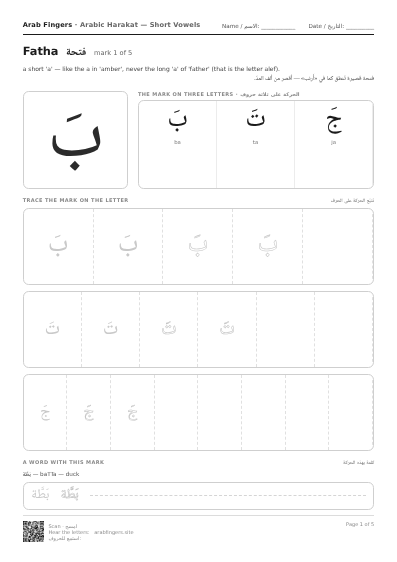
Five sheets covering fatha, kasra, damma, sukoon and tanween: each mark traced onto real letters, with an example word and how the mark changes its sound.
What is on the pages
- One page per mark: fatha (َ), kasra (ِ), damma (ُ), sukoon (ْ) and tanween (ً).
- Each sheet shows the mark on three letters your child already knows — ب، ت، ج — so the mark is learned as something that sits ON letters, not a floating symbol.
- Graded tracing rows for letter+mark combinations, in the same solid-grey → hollow → empty progression as the letter sheets.
- One example word per mark, with transliteration and meaning, to trace on a dashed line.
- A plain-English explanation of the sound on every sheet — written for parents who do not read Arabic.
How to use it
Teach the marks only after your child recognises the bare letters. The letters are the furniture; harakat are the lighting — installed once the room exists.
Exaggerate the sounds in games first: 'ba-bi-bu' chanted while hopping is preparation, and it takes two minutes. Then sit down to the sheet.
Say the sound WITH the child on every traced letter, not before and not after. The mark and the sound must land in the same second to connect.
Leave sukoon and tanween for last. A firm consonant stop and a nasal ending are genuinely harder than the three short vowels; five minutes of fatha-kasra-damma first makes them easy.
Questions
What are the Arabic harakat?
Harakat are the small marks that carry the short vowels: fatha (َ) is a short 'a', kasra (ِ) is a short 'i', damma (ُ) is a short 'u', sukoon (ْ) marks no vowel, and tanween (ً ٍ ٌ) doubles a vowel into an 'an/in/un' ending. Long vowels, by contrast, are full letters: alef, waw and ya.
When should a child start learning harakat?
Once they recognise the 28 letters comfortably — usually four to eight weeks into a letter-a-day plan. Reading fully-vowelled text with harakat is how children in Arab schools learn to decode, so the marks are the bridge from 'knowing letters' to 'reading words'.
Do adults need harakat to read Arabic?
Fluent readers infer the short vowels from context, which is why newspapers drop them. Learners and children need them: without harakat, the letters ب ت ك could read 'batak', 'batik' or several other words. The marks remove the guesswork.
Ready to print
5 pages, 0.2 MB, free forever.
⬇ Download the PDFThe rest of the library
Arabic Alphabet Tracing Worksheets
28 pages · Ages 4–7
Arabic Alphabet Chart (1 page)
1 page · All ages
Arabic Numbers 1–10 Tracing Worksheets
10 pages · Ages 3–6
Arabic Numbers 11–20 Tracing Worksheets
10 pages · Ages 4–7
Arabic Letters with Harakat (Chart + Tracing)
4 pages · Ages 5–8
Arabic Tanween Worksheets (ـٌ ـً ـٍ)
3 pages · Ages 5–8
Arabic Alphabet Flashcards (28 Cut-Out Cards)
4 pages · Ages 3–7
Arabic 4-Line Copybook (Handwriting Practice)
8 pages · Ages 5–9
Arabic Handwriting for Beginners (Teens & Adults)
10 pages · Ages 10–18 & adults
Arabic Colours & Shapes Worksheets
6 pages · Ages 3–6
Arabic Animals Colouring & Word Tracing
8 pages · Ages 3–7
Arabic Fruits & Vegetables Coloring Book
8 pages · Ages 3–7
Arabic Transport Coloring Book
6 pages · Ages 3–7
Arabic Solar System Coloring Book
6 pages · Ages 4–8
Arabic Alphabet Coloring Book — Big Bubble Letters
28 pages · Ages 3–6
Ramadan & Eid Coloring Book in Arabic
6 pages · Ages 3–7
Arabic Sea Animals Coloring Book
6 pages · Ages 3–7
My Body in Arabic — Coloring Book
6 pages · Ages 3–6
The Four Seasons in Arabic — Coloring Book
4 pages · Ages 4–7
Arabic Opposites Coloring Book
5 pages · Ages 4–7
Arabic Language Day Pack (18 December)
4 pages · Ages 4–8
Complete Arabic Workbook (everything above)
176 pages · Ages 3–7