Arabic Animals Colouring & Word Tracing
Colouring buys you the four minutes in which a word actually sticks.
8 pages · PDF · 0.3 MB · Ages 3–7
⬇ Download the PDF — freeNo email, no account, no watermark.
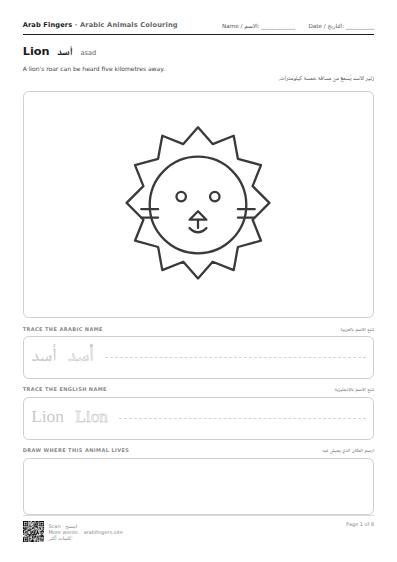
Eight animals with a large outline to colour and the animal's name to trace in both Arabic and English, with a one-line fact a parent can read aloud.
What is on the pages
- Eight animals with outlines large enough for a three-year-old's grip — no fiddly detail that ends in frustration.
- The animal's name to trace in both Arabic (أسد) and English, so the two words arrive attached to the same picture.
- A one-line fact per animal for the adult to read aloud, which is what turns a colouring page into a conversation.
How to use it
This is the pack to reach for when you want Arabic to happen without anyone noticing it is happening. Colouring occupies the hands and quiets the part of a child that resists being taught, and it lasts long enough that you can say the animal's name a dozen times conversationally.
Read the fact out in whichever language is easier for you, then say just the animal's name in Arabic. Mixing is fine and normal — a child sorts the two languages out on their own, and a parent who waits until their Arabic is good enough usually waits too long.
Questions
Which animals are in it?
Eight that a young child already recognises — the lion, cat, elephant and their neighbours. Familiar animals are chosen on purpose: the child spends their attention on the new Arabic word rather than on working out what the picture is.
Is this too easy for a six-year-old?
The colouring might be, but the word tracing is not. An older child can skip straight to tracing the names and use the outlines as a break between them — the same sheet works differently at three and at six.
Ready to print
8 pages, 0.3 MB, free forever.
⬇ Download the PDFThe rest of the library
Arabic Alphabet Tracing Worksheets
28 pages · Ages 4–7
Arabic Alphabet Chart (1 page)
1 page · All ages
Arabic Numbers 1–10 Tracing Worksheets
10 pages · Ages 3–6
Arabic Numbers 11–20 Tracing Worksheets
10 pages · Ages 4–7
Arabic Short Vowels (Harakat) Worksheets
5 pages · Ages 5–8
Arabic Letters with Harakat (Chart + Tracing)
4 pages · Ages 5–8
Arabic Tanween Worksheets (ـٌ ـً ـٍ)
3 pages · Ages 5–8
Arabic Alphabet Flashcards (28 Cut-Out Cards)
4 pages · Ages 3–7
Arabic 4-Line Copybook (Handwriting Practice)
8 pages · Ages 5–9
Arabic Handwriting for Beginners (Teens & Adults)
10 pages · Ages 10–18 & adults
Arabic Colours & Shapes Worksheets
6 pages · Ages 3–6
Arabic Fruits & Vegetables Coloring Book
8 pages · Ages 3–7
Arabic Transport Coloring Book
6 pages · Ages 3–7
Arabic Solar System Coloring Book
6 pages · Ages 4–8
Arabic Alphabet Coloring Book — Big Bubble Letters
28 pages · Ages 3–6
Ramadan & Eid Coloring Book in Arabic
6 pages · Ages 3–7
Arabic Sea Animals Coloring Book
6 pages · Ages 3–7
My Body in Arabic — Coloring Book
6 pages · Ages 3–6
The Four Seasons in Arabic — Coloring Book
4 pages · Ages 4–7
Arabic Opposites Coloring Book
5 pages · Ages 4–7
Arabic Language Day Pack (18 December)
4 pages · Ages 4–8
Complete Arabic Workbook (everything above)
176 pages · Ages 3–7