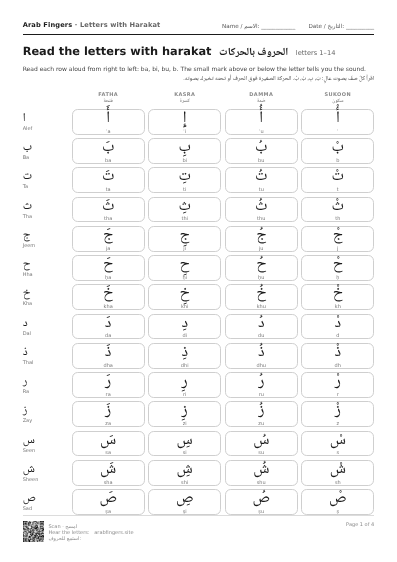
Arabic Letters with Harakat (Chart + Tracing)
Every letter with every short vowel — read it on two pages, trace it on two more.
4 pages · PDF · 0.3 MB · Ages 5–8
⬇ Download the PDF — freeNo email, no account, no watermark.
All 28 letters with fatha, kasra, damma and sukoon — بَ بِ بُ بْ — on a two-page reading chart with the sound of each, then the same grid hollow for tracing.
What is on the pages
- A two-page reading chart: all 28 letters in rows, each with fatha, kasra, damma and sukoon, and the sound printed under every syllable (ba, bi, bu, b).
- Alif written the way it is read with a vowel — أَ إِ أُ — instead of a bare alif that cannot carry one.
- Two tracing pages with the same grid in hollow outline, so the child writes each letter together with its mark.
How to use it
Read one row a day, right to left, out loud: ba, bi, bu, b. Five minutes is enough, and by the end of a month every letter has been read with every vowel.
Once a row is easy to read, trace the same row. Writing the mark is what makes a child look for it when reading.
Questions
What are harakat in Arabic?
Harakat are the small marks written above or below a letter to show its short vowel: fatha (a), kasra (i) and damma (u). Sukoon shows the letter has no vowel at all.
Should children learn the letters before the harakat?
Usually yes — a child who can name a letter is ready to read it with fatha, kasra and damma. Start with the letters they already know, not the alphabet in order.
Ready to print
4 pages, 0.3 MB, free forever.
⬇ Download the PDFThe rest of the library
Arabic Alphabet Tracing Worksheets
28 pages · Ages 4–7
Arabic Alphabet Chart (1 page)
1 page · All ages
Arabic Numbers 1–10 Tracing Worksheets
10 pages · Ages 3–6
Arabic Numbers 11–20 Tracing Worksheets
10 pages · Ages 4–7
Arabic Short Vowels (Harakat) Worksheets
5 pages · Ages 5–8
Arabic Tanween Worksheets (ـٌ ـً ـٍ)
3 pages · Ages 5–8
Arabic Alphabet Flashcards (28 Cut-Out Cards)
4 pages · Ages 3–7
Arabic 4-Line Copybook (Handwriting Practice)
8 pages · Ages 5–9
Arabic Handwriting for Beginners (Teens & Adults)
10 pages · Ages 10–18 & adults
Arabic Colours & Shapes Worksheets
6 pages · Ages 3–6
Arabic Animals Colouring & Word Tracing
8 pages · Ages 3–7
Arabic Fruits & Vegetables Coloring Book
8 pages · Ages 3–7
Arabic Transport Coloring Book
6 pages · Ages 3–7
Arabic Solar System Coloring Book
6 pages · Ages 4–8
Arabic Alphabet Coloring Book — Big Bubble Letters
28 pages · Ages 3–6
Ramadan & Eid Coloring Book in Arabic
6 pages · Ages 3–7
Arabic Sea Animals Coloring Book
6 pages · Ages 3–7
My Body in Arabic — Coloring Book
6 pages · Ages 3–6
The Four Seasons in Arabic — Coloring Book
4 pages · Ages 4–7
Arabic Opposites Coloring Book
5 pages · Ages 4–7
Arabic Language Day Pack (18 December)
4 pages · Ages 4–8
Complete Arabic Workbook (everything above)
176 pages · Ages 3–7